Hey everyone, if you’ve ever shopped around for spray painting robots (guilty, I’m the go-to for these bad boys, so I hear all the questions), one of the most common panic questions I get is: “How much actual space do these things take? Because my shop’s ceiling’s lower than a beer pong table and my parts line’s crammed like a NYC subway car at rush hour.” Fair—space is everything when you’re outfitting a workshop, not just some big, empty warehouse. Let’s break this down like we’re troubleshooting a bot that’s skipping paint: no fancy jargon, just real, workable info. Spray Painting Robot
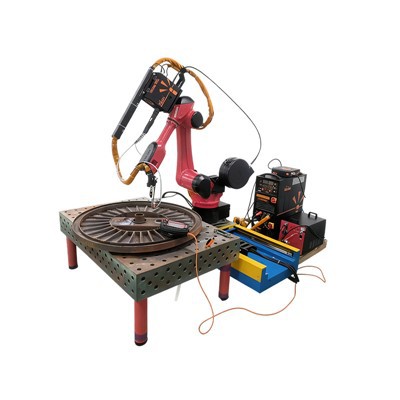
First, let’s get one thing straight: there’s no one-size-fits-all “space number.” That’s the lie some sketchy suppliers push (you know the ones—they’ll say “2x2x2 feet!” then your robot can’t swing a 10-inch part without hitting a air hose). Space depends on three huge factors: the robot’s arm reach, the size of the parts you’re painting, and how much extra room you need for movement, loading parts, and all that messy shop stuff that never shows up on floor plans.
Let’s start with the robot’s arm itself—this is non-negotiable. Most of the spray painting robots I sell are 6-axis, right? They’re the workhorses, not the tiny, tabletop ones for model cars. A standard entry-level 6-axis spray bot has a reach of, say, 1.5 meters (that’s about 5 feet) up to a heavy-duty one with 3 meters (10 feet) of reach. Here’s the math I do with customers: take the arm’s maximum reach, then add 10–15% of that on all sides. Wait, why? Because when the arm is fully extended, it’s not just the arm length—you’ve got the paint gun nozzle sticking out, maybe a color change valve on the end, that’s an extra 6–12 inches right there. If you skip that, you’ll have a robot that clunks into your part fixture mid-spray, and suddenly you’re paying for a new paint gun and a dented bumper on your part. I’ve seen this happen to a customer in Ohio last year—he measured only the arm, forgot the nozzle, and his first run left a shiny scratch on every door panel. Oops.
Now, parts size. If you’re painting tiny stuff—like bicycle handlebars, small metal brackets, or plastic toys—you don’t need a lot of extra space. For a part that’s 30cm (1 foot) long, a bot with 1.5m reach only needs a work area of like 2m x 2m (6.5ft x 6.5ft) with a 2.5m (8ft) ceiling height. But if you’re painting car hoods, full motorcycle frames, or large agricultural equipment parts? That’s a whole different game. A car hood is like 1.8m (6ft) long—so your robot needs enough space to move the hood around, plus room to load/unload it. Last quarter I worked with a customer in Texas who paints semi-truck cabs; his robot has a 2.8m (9ft) reach, and the work cell needed a 5m x 4m (16ft x 13ft) footprint, with a 3.5m (11.5ft) ceiling. He tried cutting corners on the height at first, and the robot’s elbow kept knocking the spray booth’s ceiling lights. That’s a $500 light repair and a week of downtime—way more than just installing the booth at the right height.
Then there’s the “extra” space I call the “oh-shit zone” and the loading/unloading zone. The oh-shit zone is the room you need in case you have to reposition a part mid-paint, or if a color change goes wrong and you need to move the arm away quickly. Most people forget about the loading/unloading zone too—you can’t have your operator stuck reaching into a tiny box to put parts on fixtures. That’s a safety hazard, plus it slows down production. For small parts, I tell customers to leave a 1m (3ft) clear area on one side of the robot for loading. For big parts, that’s 2m (6ft) minimum. And if you’re using a conveyor line (which 90% of my customers do for continuous production), you need to add the length of the conveyor into the space plan too. I once had a customer in Michigan who installed a conveyor that was only 1m longer than the robot’s max reach—by the time the part was on the conveyor, the robot couldn’t reach it. He had to rip out 10 feet of floor to fix it. Don’t be that guy.
Wait, what about booth size? Because most spray painting robots live inside a spray booth, right? It’s not just the robot’s space—it’s the booth’s space. The booth has to be big enough to contain overspray, which means more space on all sides of the robot. A good rule: booth size is robot space plus 1m (3ft) on all sides. For example, if your robot’s work area is 2m x 2m, your booth needs to be at least 4m x 4m. Why? Because overspray doesn’t just stay in the middle—it drifts, and you don’t want it coating the booth walls or the robot’s control panel. I also tell people to check booth height against the robot’s max vertical reach. A robot with a 3m reach can’t live in a booth with a 3m ceiling—you need at least 0.5m (1.5ft) extra clearance at the top for the arm to move without hitting.
Also, don’t forget about peripheral equipment. Where are you putting the control cabinet? The paint pumps, the color change system, the air compressors? Those don’t take up a ton of space, but they need to be near the robot (like 1–2 meters away) so the hoses and cables don’t stretch too much. If you tuck them behind a wall, you’ll be crawling around under there every time you need to fix a hose, which is not fun. Last month a customer in California tried hiding his control cabinet in a corner, and his maintenance guy had to take apart half the work cell to replace a paint filter. Total waste of time.
Let’s give you real, example numbers to make this concrete, because I know you love that.
Example 1: Small workshop, painting bicycle parts (handlebars, frames, brackets). Robot: 1.5m (5ft) reach 6-axis spray bot. Total needed space: Work cell = 2.5m x 2.5m (8ft x 8ft), ceiling height = 2.7m (9ft). Booth size: 4m x 3m (13ft x 10ft). That’s it—fits in a spot that’s not way bigger than a standard shipping container, perfect for small shops.
Example 2: Medium workshop, painting car parts (doors, hoods, trunk lids). Robot: 2.5m (8ft) reach heavy-duty spray bot. Total needed space: Work cell = 4m x 3.5m (13ft x 11.5ft), ceiling height = 3.2m (10.5ft). Booth size: 6m x 4.5m (20ft x 15ft). This fits in a 20x20ft shop area, no problem.
Example 3: Large workshop, painting semi-truck cabs or agricultural equipment. Robot: 3m (10ft) reach heavy-duty spray bot. Total needed space: Work cell = 5.5m x 4.5m (18ft x 15ft), ceiling height = 3.8m (12.5ft). Booth size: 7m x 5.5m (23ft x 18ft). That’s a bit bigger, but worth it for the production speed.
Now, what if you have a weirdly shaped shop? Like, low ceilings, odd corners, columns in the way? I get that—most shops aren’t perfect squares. That’s why I always do a free site assessment (no, I don’t charge for the quick walkthrough) before I quote a robot. Last year I had a customer in Chicago who had a 2.5m (8ft) ceiling, which is too low for a standard 1.5m reach robot. So we swapped him for a compact robot with a 1.2m (4ft) reach, and reworked his work cell to use a rotating part fixture instead of moving the arm up and down. He saved money on the robot too, and fits perfectly in his existing shop. The biggest mistake people make here is forcing a one-size-fits-all bot into a bad space—you’ll end up with a bot that’s underpowered or can’t move properly, which defeats the whole point of getting a spray robot (less waste, more consistent paint, faster production).
Wait, also: don’t forget about safety zones. If you’re running the robot, you don’t want anyone walking into the work cell while it’s moving. So most robots have safety scanners that stop the arm if someone gets too close, but you still need to mark a physical safety zone on the floor. That adds like 0.5m (1.5ft) around the work cell, so factor that in too. It’s not extra work space you use, but it’s space you have to leave clear.
Another thing: if you’re ever expanding your shop later, leave a little extra space. I always tell customers to add 10% to their total space estimate for future growth. You don’t want to have to move your robot and booth in 2 years because you got a new line of parts and the old space is too small. Trust me, I’ve seen that more times than I can count.

So, to wrap this up: there’s no magic number for spray painting robot space. It’s all about your robot’s reach, your parts size, loading/unloading, safety, and booth needs. Don’t just go by the robot’s listed reach—add 10% extra, plus space for your parts and operators to work, plus room for peripherals. If you’re not sure, just reach out— I’ll walk you through what works for your shop, no pressure, no weird fine print. We can talk through your parts, your shop layout, even help with a quick site check if you need it. Stop guessing and get a robot that fits your space, not the other way around. Let’s get your painting line running smoothly.
Injection Molding Robot Arm References
- Robotic Industries Association. (2022). Safety and Space Requirements for Industrial Robotic Workcells.
- Society of Manufacturing Engineers. (2021). Optimizing Workcell Layout for Spray Painting Applications.
- International Organization for Standardization. (2019). ISO 10218-1: Safety of Industrial Robots – Part 1: General Requirements.
Dongguan Chuanglida Intelligent Equipments Co., Ltd.
As one of the most professional spray painting robot manufacturers and suppliers in China, we also support customized service. Please feel free to buy discount spray painting robot in stock here from our factory. For price consultation, contact us.
Address: Room 201, Building 2, No.61, Shachang 1st Road, Dalang Town, Dongguan City, Guangdong Province
E-mail: haoguangli001@outlook.com
WebSite: https://www.boruntestech.com/
